


Home
Mathematics and Metaphilosophy
Barnes and Noble
Loading Inventory...
Mathematics and Metaphilosophy in Bloomington, MN
Current price: $23.00

Mathematics and Metaphilosophy in Bloomington, MN
Current price: $23.00
Loading Inventory...
Size: Paperback
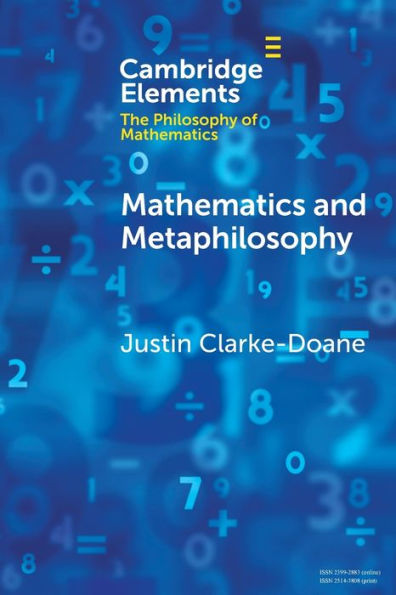
This Element discusses the problem of mathematical knowledge, and its broader philosophical ramifications. It argues that the challenge to explain the (defeasible) justification of our mathematical beliefs ('the justificatory challenge'), arises insofar as disagreement over axioms bottoms out in disagreement over intuitions. And it argues that the challenge to explain their reliability ('the reliability challenge'), arises to the extent that we could have easily had different beliefs. The Element shows that mathematical facts are not, in general, empirically accessible, contra Quine, and that they cannot be dispensed with, contra Field. However, it argues that they might be so plentiful that our knowledge of them is unmysterious. The Element concludes with a complementary 'pluralism' about modality, logic and normative theory, highlighting its surprising implications. Metaphysically, pluralism engenders a kind of perspectivalism and indeterminacy. Methodologically, it vindicates Carnap's pragmatism, transposed to the key of realism.
This Element discusses the problem of mathematical knowledge, and its broader philosophical ramifications. It argues that the challenge to explain the (defeasible) justification of our mathematical beliefs ('the justificatory challenge'), arises insofar as disagreement over axioms bottoms out in disagreement over intuitions. And it argues that the challenge to explain their reliability ('the reliability challenge'), arises to the extent that we could have easily had different beliefs. The Element shows that mathematical facts are not, in general, empirically accessible, contra Quine, and that they cannot be dispensed with, contra Field. However, it argues that they might be so plentiful that our knowledge of them is unmysterious. The Element concludes with a complementary 'pluralism' about modality, logic and normative theory, highlighting its surprising implications. Metaphysically, pluralism engenders a kind of perspectivalism and indeterminacy. Methodologically, it vindicates Carnap's pragmatism, transposed to the key of realism.
Shop Similar Products











Find at Mall of America® in Bloomington, MN
Visit at Mall of America® in Bloomington, MN