


Home
Mastering Python for Bioinformatics: How to Write Flexible, Documented, Tested Code Research Computing
Barnes and Noble
Loading Inventory...
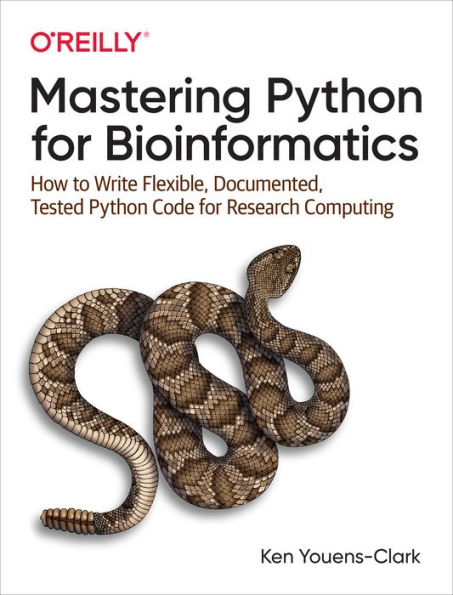
Mastering Python for Bioinformatics: How to Write Flexible, Documented, Tested Code Research Computing in Bloomington, MN
Current price: $99.99

Mastering Python for Bioinformatics: How to Write Flexible, Documented, Tested Code Research Computing in Bloomington, MN
Current price: $99.99
Loading Inventory...
Size: Paperback
Life scientists today urgently need training in bioinformatics skills. Too many bioinformatics programs are poorly written and barely maintained, usually by students and researchers who've never learned basic programming skills. This practical guide shows postdoc bioinformatics professionals and students how to exploit the best parts of Python to solve problems in biology while creating documented, tested, reproducible software.
Ken Youens-Clark, author of
Tiny Python Projects
(Manning), demonstrates not only how to write effective Python code but also how to use tests to write and refactor scientific programs. You'll learn the latest Python features and tools including linters, formatters, type checkers, and tests to create documented and tested programs. You'll also tackle 14 challenges in Rosalind, a problem-solving platform for learning bioinformatics and programming.
Create command-line Python programs to document and validate parameters
Write tests to verify refactor programs and confirm they're correct
Address bioinformatics ideas using Python data structures and modules such as Biopython
Create reproducible shortcuts and workflows using makefiles
Parse essential bioinformatics file formats such as FASTA and FASTQ
Find patterns of text using regular expressions
Use higher-order functions in Python like filter(), map(), and reduce()
Ken Youens-Clark, author of
Tiny Python Projects
(Manning), demonstrates not only how to write effective Python code but also how to use tests to write and refactor scientific programs. You'll learn the latest Python features and tools including linters, formatters, type checkers, and tests to create documented and tested programs. You'll also tackle 14 challenges in Rosalind, a problem-solving platform for learning bioinformatics and programming.
Create command-line Python programs to document and validate parameters
Write tests to verify refactor programs and confirm they're correct
Address bioinformatics ideas using Python data structures and modules such as Biopython
Create reproducible shortcuts and workflows using makefiles
Parse essential bioinformatics file formats such as FASTA and FASTQ
Find patterns of text using regular expressions
Use higher-order functions in Python like filter(), map(), and reduce()
Life scientists today urgently need training in bioinformatics skills. Too many bioinformatics programs are poorly written and barely maintained, usually by students and researchers who've never learned basic programming skills. This practical guide shows postdoc bioinformatics professionals and students how to exploit the best parts of Python to solve problems in biology while creating documented, tested, reproducible software.
Ken Youens-Clark, author of
Tiny Python Projects
(Manning), demonstrates not only how to write effective Python code but also how to use tests to write and refactor scientific programs. You'll learn the latest Python features and tools including linters, formatters, type checkers, and tests to create documented and tested programs. You'll also tackle 14 challenges in Rosalind, a problem-solving platform for learning bioinformatics and programming.
Create command-line Python programs to document and validate parameters
Write tests to verify refactor programs and confirm they're correct
Address bioinformatics ideas using Python data structures and modules such as Biopython
Create reproducible shortcuts and workflows using makefiles
Parse essential bioinformatics file formats such as FASTA and FASTQ
Find patterns of text using regular expressions
Use higher-order functions in Python like filter(), map(), and reduce()
Ken Youens-Clark, author of
Tiny Python Projects
(Manning), demonstrates not only how to write effective Python code but also how to use tests to write and refactor scientific programs. You'll learn the latest Python features and tools including linters, formatters, type checkers, and tests to create documented and tested programs. You'll also tackle 14 challenges in Rosalind, a problem-solving platform for learning bioinformatics and programming.
Create command-line Python programs to document and validate parameters
Write tests to verify refactor programs and confirm they're correct
Address bioinformatics ideas using Python data structures and modules such as Biopython
Create reproducible shortcuts and workflows using makefiles
Parse essential bioinformatics file formats such as FASTA and FASTQ
Find patterns of text using regular expressions
Use higher-order functions in Python like filter(), map(), and reduce()
Shop Similar Products











Find at Mall of America® in Bloomington, MN
Visit at Mall of America® in Bloomington, MN