


Home
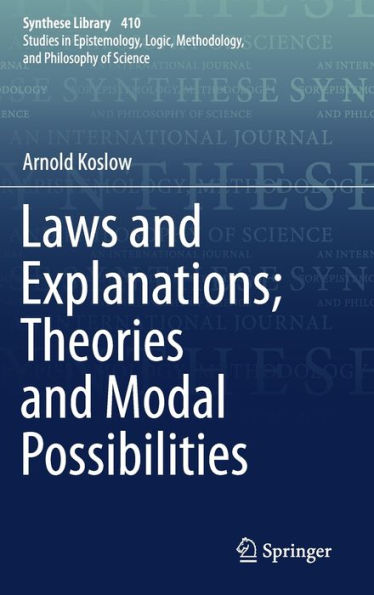
Laws and Explanations; Theories Modal Possibilities
Barnes and Noble
Loading Inventory...
Laws and Explanations; Theories Modal Possibilities in Bloomington, MN
Current price: $99.99

Laws and Explanations; Theories Modal Possibilities in Bloomington, MN
Current price: $99.99
Loading Inventory...
Size: Hardcover
The book has two parts: In the first, after a review of some seminal classical accounts of laws and explanations, a new account is proposed for distinguishing between laws and accidental generalizations (LAG). Among the new consequences of this proposal it is proved that any explanation of a contingent generalization shows that the generalization is not accidental. The second part involves
physical
theories, their modality, and their explanatory power. In particular, it is shown that (1) Each theory has a theoretical implication structure associated with it, such that there are new
modal operators
on
these structures and also special modal entities that are
in
these structures. A special subset of the physical modals, the
nomic
modals are associated with the laws of theories. (2) The familiar idea that theories always explain laws by deduction of them has to be seriously modified in light of the fact that there are a host of physical theories (including for example, Newtonian Classical mechanics, Hamiltonian, and Lagrangian theory, and probability theory) that we believe are
schematic
(they do not have any truth value). Nevertheless, we think that there is a kind of non-deductive explanation and generality that they achieve by subsumtion under a schema.
physical
theories, their modality, and their explanatory power. In particular, it is shown that (1) Each theory has a theoretical implication structure associated with it, such that there are new
modal operators
on
these structures and also special modal entities that are
in
these structures. A special subset of the physical modals, the
nomic
modals are associated with the laws of theories. (2) The familiar idea that theories always explain laws by deduction of them has to be seriously modified in light of the fact that there are a host of physical theories (including for example, Newtonian Classical mechanics, Hamiltonian, and Lagrangian theory, and probability theory) that we believe are
schematic
(they do not have any truth value). Nevertheless, we think that there is a kind of non-deductive explanation and generality that they achieve by subsumtion under a schema.
The book has two parts: In the first, after a review of some seminal classical accounts of laws and explanations, a new account is proposed for distinguishing between laws and accidental generalizations (LAG). Among the new consequences of this proposal it is proved that any explanation of a contingent generalization shows that the generalization is not accidental. The second part involves
physical
theories, their modality, and their explanatory power. In particular, it is shown that (1) Each theory has a theoretical implication structure associated with it, such that there are new
modal operators
on
these structures and also special modal entities that are
in
these structures. A special subset of the physical modals, the
nomic
modals are associated with the laws of theories. (2) The familiar idea that theories always explain laws by deduction of them has to be seriously modified in light of the fact that there are a host of physical theories (including for example, Newtonian Classical mechanics, Hamiltonian, and Lagrangian theory, and probability theory) that we believe are
schematic
(they do not have any truth value). Nevertheless, we think that there is a kind of non-deductive explanation and generality that they achieve by subsumtion under a schema.
physical
theories, their modality, and their explanatory power. In particular, it is shown that (1) Each theory has a theoretical implication structure associated with it, such that there are new
modal operators
on
these structures and also special modal entities that are
in
these structures. A special subset of the physical modals, the
nomic
modals are associated with the laws of theories. (2) The familiar idea that theories always explain laws by deduction of them has to be seriously modified in light of the fact that there are a host of physical theories (including for example, Newtonian Classical mechanics, Hamiltonian, and Lagrangian theory, and probability theory) that we believe are
schematic
(they do not have any truth value). Nevertheless, we think that there is a kind of non-deductive explanation and generality that they achieve by subsumtion under a schema.
Shop Similar Products












Find at Mall of America® in Bloomington, MN
Visit at Mall of America® in Bloomington, MN