


Home
Essays on Wage Bargaining Dynamic Macroeconomics
Barnes and Noble
Loading Inventory...
Essays on Wage Bargaining Dynamic Macroeconomics in Bloomington, MN
Current price: $69.99

Essays on Wage Bargaining Dynamic Macroeconomics in Bloomington, MN
Current price: $69.99
Loading Inventory...
Size: Paperback
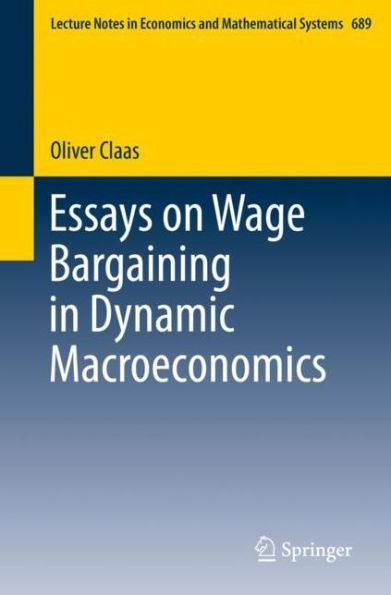
This book addresses collective bargaining in an intertemporal monetary macroeconomy of the aggregate supply–aggregate demand (AS–AD) type with overlapping generations of consumers and with a public sector. The results are presented in a unified framework with a commodity market that clears competitively. By analyzing the implications of three variants of collective bargaining – efficient bargaining in a uniform and a segmented labor market and “right-to-manage” wage bargaining – it identifies the quantity of money, price expectations, union power, and union size as the determinants of temporary equilibria. In the three scenarios, it characterizes and compares the temporary equilibria using both analytical and numerical techniques, with an emphasis on allocations, welfare, and efficiency. It also discusses the dynamic evolution under rational expectations and its steady states in nominal and real terms. Lastly, it demonstrates conditions for stability regarding a balanced monetary expansion of the economy.
This book addresses collective bargaining in an intertemporal monetary macroeconomy of the aggregate supply–aggregate demand (AS–AD) type with overlapping generations of consumers and with a public sector. The results are presented in a unified framework with a commodity market that clears competitively. By analyzing the implications of three variants of collective bargaining – efficient bargaining in a uniform and a segmented labor market and “right-to-manage” wage bargaining – it identifies the quantity of money, price expectations, union power, and union size as the determinants of temporary equilibria. In the three scenarios, it characterizes and compares the temporary equilibria using both analytical and numerical techniques, with an emphasis on allocations, welfare, and efficiency. It also discusses the dynamic evolution under rational expectations and its steady states in nominal and real terms. Lastly, it demonstrates conditions for stability regarding a balanced monetary expansion of the economy.
Shop Similar Products













Find at Mall of America® in Bloomington, MN
Visit at Mall of America® in Bloomington, MN