


Home
Entrepreneurial Vernacular: Developers' Subdivisions the 1920s
Barnes and Noble
Loading Inventory...
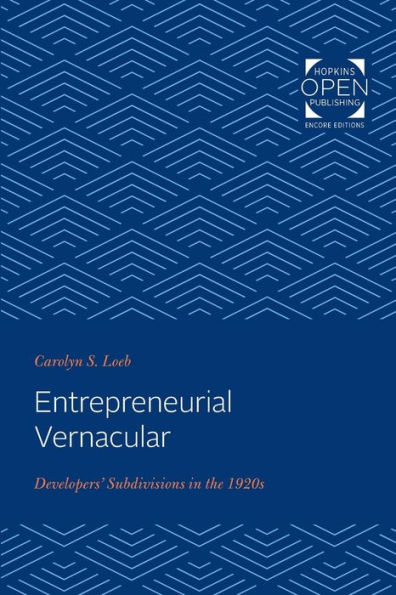
Entrepreneurial Vernacular: Developers' Subdivisions the 1920s in Bloomington, MN
Current price: $47.95

Entrepreneurial Vernacular: Developers' Subdivisions the 1920s in Bloomington, MN
Current price: $47.95
Loading Inventory...
Size: Paperback
During the 1920s, enterprising realtors, housing professionals, and builders developed the models that became the inspiration for the subdivision tract housing now commonplace in the U.S.
Originally published in 2001. Suburban subdivisions of individual family homes are so familiar a part of the American landscape that it is hard to imagine a time when they were not common in the U. S. The shift to large-scale speculative subdivisions is usually attributed to the period after World War II. In
Entrepreneurial Vernacular: Developers' Subdivisions in the 1920s
, Carolyn S. Loeb shows that the precedents for this change in single-family home design were the result of concerted efforts by entrepreneurial realtors and other housing professionals during the 1920s. In her discussion of the historical and structural forces that propelled this change, Loeb focuses on three typical speculative subdivisions of the 1920s and on the realtors, architects, and building-craftsmen who designed and constructed them. These examples highlight the "shared set of planning and design concerns" that animated realtors (whom Loeb sees as having played the "key role" in this process) and the network of housing experts with whom they associated. Decentralized and loosely coordinated, this network promoted home ownership through flexible strategies of design, planning, financing, and construction which the author describes as a new and "entrepreneurial" vernacular.
Originally published in 2001. Suburban subdivisions of individual family homes are so familiar a part of the American landscape that it is hard to imagine a time when they were not common in the U. S. The shift to large-scale speculative subdivisions is usually attributed to the period after World War II. In
Entrepreneurial Vernacular: Developers' Subdivisions in the 1920s
, Carolyn S. Loeb shows that the precedents for this change in single-family home design were the result of concerted efforts by entrepreneurial realtors and other housing professionals during the 1920s. In her discussion of the historical and structural forces that propelled this change, Loeb focuses on three typical speculative subdivisions of the 1920s and on the realtors, architects, and building-craftsmen who designed and constructed them. These examples highlight the "shared set of planning and design concerns" that animated realtors (whom Loeb sees as having played the "key role" in this process) and the network of housing experts with whom they associated. Decentralized and loosely coordinated, this network promoted home ownership through flexible strategies of design, planning, financing, and construction which the author describes as a new and "entrepreneurial" vernacular.
During the 1920s, enterprising realtors, housing professionals, and builders developed the models that became the inspiration for the subdivision tract housing now commonplace in the U.S.
Originally published in 2001. Suburban subdivisions of individual family homes are so familiar a part of the American landscape that it is hard to imagine a time when they were not common in the U. S. The shift to large-scale speculative subdivisions is usually attributed to the period after World War II. In
Entrepreneurial Vernacular: Developers' Subdivisions in the 1920s
, Carolyn S. Loeb shows that the precedents for this change in single-family home design were the result of concerted efforts by entrepreneurial realtors and other housing professionals during the 1920s. In her discussion of the historical and structural forces that propelled this change, Loeb focuses on three typical speculative subdivisions of the 1920s and on the realtors, architects, and building-craftsmen who designed and constructed them. These examples highlight the "shared set of planning and design concerns" that animated realtors (whom Loeb sees as having played the "key role" in this process) and the network of housing experts with whom they associated. Decentralized and loosely coordinated, this network promoted home ownership through flexible strategies of design, planning, financing, and construction which the author describes as a new and "entrepreneurial" vernacular.
Originally published in 2001. Suburban subdivisions of individual family homes are so familiar a part of the American landscape that it is hard to imagine a time when they were not common in the U. S. The shift to large-scale speculative subdivisions is usually attributed to the period after World War II. In
Entrepreneurial Vernacular: Developers' Subdivisions in the 1920s
, Carolyn S. Loeb shows that the precedents for this change in single-family home design were the result of concerted efforts by entrepreneurial realtors and other housing professionals during the 1920s. In her discussion of the historical and structural forces that propelled this change, Loeb focuses on three typical speculative subdivisions of the 1920s and on the realtors, architects, and building-craftsmen who designed and constructed them. These examples highlight the "shared set of planning and design concerns" that animated realtors (whom Loeb sees as having played the "key role" in this process) and the network of housing experts with whom they associated. Decentralized and loosely coordinated, this network promoted home ownership through flexible strategies of design, planning, financing, and construction which the author describes as a new and "entrepreneurial" vernacular.
Shop Similar Products















Find at Mall of America® in Bloomington, MN
Visit at Mall of America® in Bloomington, MN