


Home
Elixir: A Parisian Perfume House and the Quest for Secret of Life
Barnes and Noble
Loading Inventory...
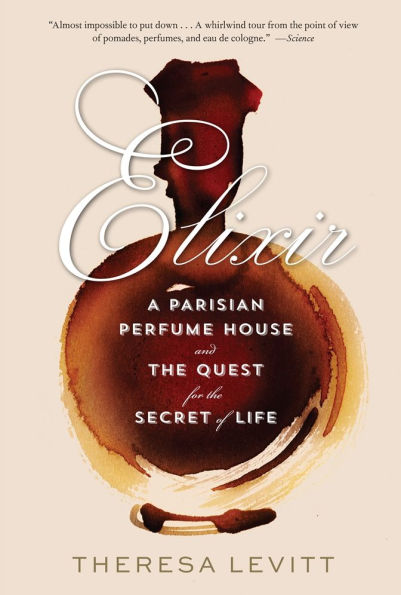
Elixir: A Parisian Perfume House and the Quest for Secret of Life in Bloomington, MN
Current price: $19.99

Elixir: A Parisian Perfume House and the Quest for Secret of Life in Bloomington, MN
Current price: $19.99
Loading Inventory...
Size: Audiobook
A
Financial Times
Best History Book of the Year
Summer Reading Favorite
“[V]ividly evokes cultural life in Bohemian Paris, the turbulence of the French Revolution and its aftermath, and the feuds that plagued rival scientists…Levitt’s social history, especially of perfume, is fascinating.” —
Wall Street Journal
“A delightful history of science and scent at the dawn of the modern age.” —
“Pulling from historical publications and personal writings, Theresa Levitt vividly explains why perfume—bathed in, lathered on, and orally consumed—had a chokehold on Parisian life.” —Scientific American
“[A] fascinating account of the birth pangs of organic chemistry in 19th-century Paris…[Levitt] has caught well these dreaming, competitive, daring men in the act of living, each striving compulsively for the giddy, intoxicating bliss of insight into the making of the world.” —
The Times
Until the 1800s, scientists believed that living matter possessed a spirit or essence that differentiated it from nonliving matter. But even as scientific consensus shifted toward the view that all matter shares the same building blocks, some were not convinced.
Elixir
tells the story of two dissenters—chemists who redrew the boundary between life and nonlife. In the 1830s, Édouard Laugier and Auguste Laurent worked at Laugier Père et Fils, the oldest perfume house in Paris. By day, they prepared the perfumery’s revitalizing elixirs and rejuvenating eaux. In their spare time, they hunted the vital force underlying life itself. Their ideas, roundly condemned by established chemists, led to the discovery of structural differences between naturally occurring molecules and their synthetic counterparts.
Scientists still can’t explain this anomaly, but it may point to critical insights concerning the origins of life. Rich in sparks and smells, brimming with eccentric characters, experimental audacity, and the romance of the Bohemian salon,
gives a fascinating tour of the alchemical revelations that shaped nineteenth-century Paris—and the modern world.
Financial Times
Best History Book of the Year
Summer Reading Favorite
“[V]ividly evokes cultural life in Bohemian Paris, the turbulence of the French Revolution and its aftermath, and the feuds that plagued rival scientists…Levitt’s social history, especially of perfume, is fascinating.” —
Wall Street Journal
“A delightful history of science and scent at the dawn of the modern age.” —
“Pulling from historical publications and personal writings, Theresa Levitt vividly explains why perfume—bathed in, lathered on, and orally consumed—had a chokehold on Parisian life.” —Scientific American
“[A] fascinating account of the birth pangs of organic chemistry in 19th-century Paris…[Levitt] has caught well these dreaming, competitive, daring men in the act of living, each striving compulsively for the giddy, intoxicating bliss of insight into the making of the world.” —
The Times
Until the 1800s, scientists believed that living matter possessed a spirit or essence that differentiated it from nonliving matter. But even as scientific consensus shifted toward the view that all matter shares the same building blocks, some were not convinced.
Elixir
tells the story of two dissenters—chemists who redrew the boundary between life and nonlife. In the 1830s, Édouard Laugier and Auguste Laurent worked at Laugier Père et Fils, the oldest perfume house in Paris. By day, they prepared the perfumery’s revitalizing elixirs and rejuvenating eaux. In their spare time, they hunted the vital force underlying life itself. Their ideas, roundly condemned by established chemists, led to the discovery of structural differences between naturally occurring molecules and their synthetic counterparts.
Scientists still can’t explain this anomaly, but it may point to critical insights concerning the origins of life. Rich in sparks and smells, brimming with eccentric characters, experimental audacity, and the romance of the Bohemian salon,
gives a fascinating tour of the alchemical revelations that shaped nineteenth-century Paris—and the modern world.
A
Financial Times
Best History Book of the Year
Summer Reading Favorite
“[V]ividly evokes cultural life in Bohemian Paris, the turbulence of the French Revolution and its aftermath, and the feuds that plagued rival scientists…Levitt’s social history, especially of perfume, is fascinating.” —
Wall Street Journal
“A delightful history of science and scent at the dawn of the modern age.” —
“Pulling from historical publications and personal writings, Theresa Levitt vividly explains why perfume—bathed in, lathered on, and orally consumed—had a chokehold on Parisian life.” —Scientific American
“[A] fascinating account of the birth pangs of organic chemistry in 19th-century Paris…[Levitt] has caught well these dreaming, competitive, daring men in the act of living, each striving compulsively for the giddy, intoxicating bliss of insight into the making of the world.” —
The Times
Until the 1800s, scientists believed that living matter possessed a spirit or essence that differentiated it from nonliving matter. But even as scientific consensus shifted toward the view that all matter shares the same building blocks, some were not convinced.
Elixir
tells the story of two dissenters—chemists who redrew the boundary between life and nonlife. In the 1830s, Édouard Laugier and Auguste Laurent worked at Laugier Père et Fils, the oldest perfume house in Paris. By day, they prepared the perfumery’s revitalizing elixirs and rejuvenating eaux. In their spare time, they hunted the vital force underlying life itself. Their ideas, roundly condemned by established chemists, led to the discovery of structural differences between naturally occurring molecules and their synthetic counterparts.
Scientists still can’t explain this anomaly, but it may point to critical insights concerning the origins of life. Rich in sparks and smells, brimming with eccentric characters, experimental audacity, and the romance of the Bohemian salon,
gives a fascinating tour of the alchemical revelations that shaped nineteenth-century Paris—and the modern world.
Financial Times
Best History Book of the Year
Summer Reading Favorite
“[V]ividly evokes cultural life in Bohemian Paris, the turbulence of the French Revolution and its aftermath, and the feuds that plagued rival scientists…Levitt’s social history, especially of perfume, is fascinating.” —
Wall Street Journal
“A delightful history of science and scent at the dawn of the modern age.” —
“Pulling from historical publications and personal writings, Theresa Levitt vividly explains why perfume—bathed in, lathered on, and orally consumed—had a chokehold on Parisian life.” —Scientific American
“[A] fascinating account of the birth pangs of organic chemistry in 19th-century Paris…[Levitt] has caught well these dreaming, competitive, daring men in the act of living, each striving compulsively for the giddy, intoxicating bliss of insight into the making of the world.” —
The Times
Until the 1800s, scientists believed that living matter possessed a spirit or essence that differentiated it from nonliving matter. But even as scientific consensus shifted toward the view that all matter shares the same building blocks, some were not convinced.
Elixir
tells the story of two dissenters—chemists who redrew the boundary between life and nonlife. In the 1830s, Édouard Laugier and Auguste Laurent worked at Laugier Père et Fils, the oldest perfume house in Paris. By day, they prepared the perfumery’s revitalizing elixirs and rejuvenating eaux. In their spare time, they hunted the vital force underlying life itself. Their ideas, roundly condemned by established chemists, led to the discovery of structural differences between naturally occurring molecules and their synthetic counterparts.
Scientists still can’t explain this anomaly, but it may point to critical insights concerning the origins of life. Rich in sparks and smells, brimming with eccentric characters, experimental audacity, and the romance of the Bohemian salon,
gives a fascinating tour of the alchemical revelations that shaped nineteenth-century Paris—and the modern world.
Shop Similar Products









Find at Mall of America® in Bloomington, MN
Visit at Mall of America® in Bloomington, MN