


Home
Decay processes in highly turbulent plasma
Barnes and Noble
Loading Inventory...
Decay processes in highly turbulent plasma in Bloomington, MN
Current price: $50.00

Decay processes in highly turbulent plasma in Bloomington, MN
Current price: $50.00
Loading Inventory...
Size: OS
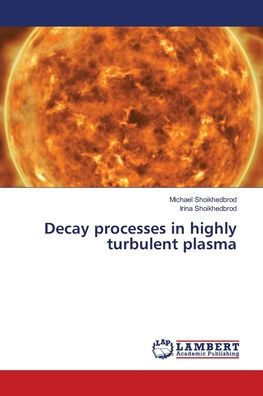
The authors obtained a general formula for calculating the probabilities of such decay processes as l2 + S → l1, l + l → t, that is, the merging of Langmuir and ion-acoustic waves, and the merging of two Langmuir waves into a transverse wave with Langmuir plasma frequency in isotropic and highly turbulent plasma, using the statistical method, and found that the highly turbulent case differ from the isotropic case by addition an amount of the order of magnitude. Using a statistical description of the state of Langmuir turbulence with a developed modulation disturbance, the authors come to the conclusion about the transformation of turbulence energy to particles. It was obtained that oscillations with large wave numbers are formed in process l2 + S → l1: (vector) k1 = (vector) k2 + (vector) k3S, and in process l + l → t: (vector) k3t = (vector) k1l + (vector) k2l, which leads to the concentration of oscillations in the region of large wave numbers, and consequently to a change in the direction of the initial oscillation energy into the Landau damping region, and subsequent heating of the plasma.
The authors obtained a general formula for calculating the probabilities of such decay processes as l2 + S → l1, l + l → t, that is, the merging of Langmuir and ion-acoustic waves, and the merging of two Langmuir waves into a transverse wave with Langmuir plasma frequency in isotropic and highly turbulent plasma, using the statistical method, and found that the highly turbulent case differ from the isotropic case by addition an amount of the order of magnitude. Using a statistical description of the state of Langmuir turbulence with a developed modulation disturbance, the authors come to the conclusion about the transformation of turbulence energy to particles. It was obtained that oscillations with large wave numbers are formed in process l2 + S → l1: (vector) k1 = (vector) k2 + (vector) k3S, and in process l + l → t: (vector) k3t = (vector) k1l + (vector) k2l, which leads to the concentration of oscillations in the region of large wave numbers, and consequently to a change in the direction of the initial oscillation energy into the Landau damping region, and subsequent heating of the plasma.











Find at Mall of America® in Bloomington, MN
Visit at Mall of America® in Bloomington, MN