


Home
Clinical Pharmacokinetics: A Short Introduction
Barnes and Noble
Loading Inventory...
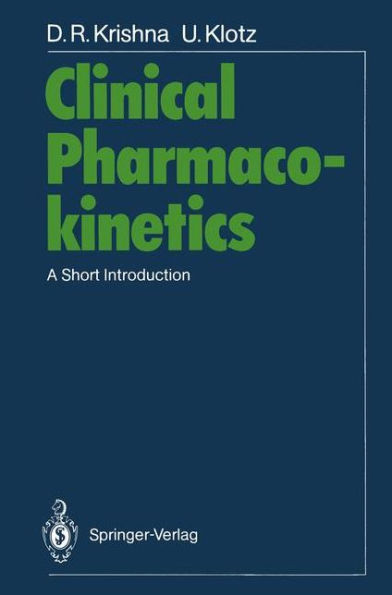
Clinical Pharmacokinetics: A Short Introduction in Bloomington, MN
Current price: $54.99

Clinical Pharmacokinetics: A Short Introduction in Bloomington, MN
Current price: $54.99
Loading Inventory...
Size: OS
The first part of this book enables the reader to be familiarized with basic concepts of pharmacokinetics (Absorption, Distribution, Metabolism and Excretion - ADM E) following single dose administration. In this part these principles are applied to clinically relevant situations, namely, multiple or (sub) chronic administration. In day to day practice besides acute drug response, often a longer duration of action is desired. This situation needs the understanding of changes in pharmacokinetics of drugs upon repeated administra tion, and the dosage regimen has to be accordingly adjusted for achieving uniform therapeutic levels for desired period of time. 2 Multiple dosing The basic mathematical relationships applicable to single dose administration kinetics are also valid (with slight modifications) for multiple dose kinetics. In multiple dose therapy the ultimate purpose is to achieve a steady drug effect or response with minimum side effects. As mentioned before, this can be achieved in most cases by maintaining the plasma concentrations in therapeutic range for required number of hours or days. This may be considered as a general rule with an exception of nitrates, in which case the concentrations during the interval between two doses (called "dosing interval") should fall below a critical threshold level, such that tolerance does not develop. A drug is commonly administered in fixed doses at constant intervals of time so that the amount lost through elimination is replaced after each dose.
The first part of this book enables the reader to be familiarized with basic concepts of pharmacokinetics (Absorption, Distribution, Metabolism and Excretion - ADM E) following single dose administration. In this part these principles are applied to clinically relevant situations, namely, multiple or (sub) chronic administration. In day to day practice besides acute drug response, often a longer duration of action is desired. This situation needs the understanding of changes in pharmacokinetics of drugs upon repeated administra tion, and the dosage regimen has to be accordingly adjusted for achieving uniform therapeutic levels for desired period of time. 2 Multiple dosing The basic mathematical relationships applicable to single dose administration kinetics are also valid (with slight modifications) for multiple dose kinetics. In multiple dose therapy the ultimate purpose is to achieve a steady drug effect or response with minimum side effects. As mentioned before, this can be achieved in most cases by maintaining the plasma concentrations in therapeutic range for required number of hours or days. This may be considered as a general rule with an exception of nitrates, in which case the concentrations during the interval between two doses (called "dosing interval") should fall below a critical threshold level, such that tolerance does not develop. A drug is commonly administered in fixed doses at constant intervals of time so that the amount lost through elimination is replaced after each dose.


















Find at Mall of America® in Bloomington, MN
Visit at Mall of America® in Bloomington, MN