


Home
3D Bioprinting: Modeling Vitro Tissues and Organs Using Tissue-Specific Bioinks
Barnes and Noble
Loading Inventory...
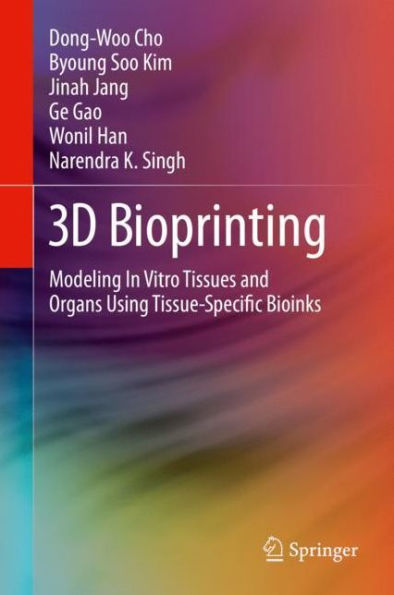
3D Bioprinting: Modeling Vitro Tissues and Organs Using Tissue-Specific Bioinks in Bloomington, MN
Current price: $64.99

3D Bioprinting: Modeling Vitro Tissues and Organs Using Tissue-Specific Bioinks in Bloomington, MN
Current price: $64.99
Loading Inventory...
Size: Hardcover
This text advances fundamental knowledge in modeling in vitro tissues/organs as an alternative to 2D cell culture and animal testing. Prior to engineering in vitro tissues/organs,the descriptions of prerequisites (from pre-processing to post-processing) in modeling in vitro tissues/organs are discussed. The most prevalent technologies that have been widely used for establishing the in vitro tissue/organ models are also described, including transwell, cell spheroids/sheets, organoids, and microfluidic-based chips. In particular, the authors focus on 3D bioprinting in vitro tissue/organ models using tissue-specific bioinks. Several representative bioprinting methods and conventional bioinks are introduced. As a bioink source, decellularized extracellular matrix (dECM) are importantly covered, including decellularization methods, evaluation methods for demonstrating successful decellularization, and material safety. Taken together, the authors delineate various application examples of 3D bioprinted in vitro tissue/organ models especially using dECM bioinks.
This text advances fundamental knowledge in modeling in vitro tissues/organs as an alternative to 2D cell culture and animal testing. Prior to engineering in vitro tissues/organs,the descriptions of prerequisites (from pre-processing to post-processing) in modeling in vitro tissues/organs are discussed. The most prevalent technologies that have been widely used for establishing the in vitro tissue/organ models are also described, including transwell, cell spheroids/sheets, organoids, and microfluidic-based chips. In particular, the authors focus on 3D bioprinting in vitro tissue/organ models using tissue-specific bioinks. Several representative bioprinting methods and conventional bioinks are introduced. As a bioink source, decellularized extracellular matrix (dECM) are importantly covered, including decellularization methods, evaluation methods for demonstrating successful decellularization, and material safety. Taken together, the authors delineate various application examples of 3D bioprinted in vitro tissue/organ models especially using dECM bioinks.
Shop Similar Products

















Find at Mall of America® in Bloomington, MN
Visit at Mall of America® in Bloomington, MN